What moved in markets on Friday 27 November 2026, why it moved and what comes next — summarised from the publishers credited below.
Market snapshot
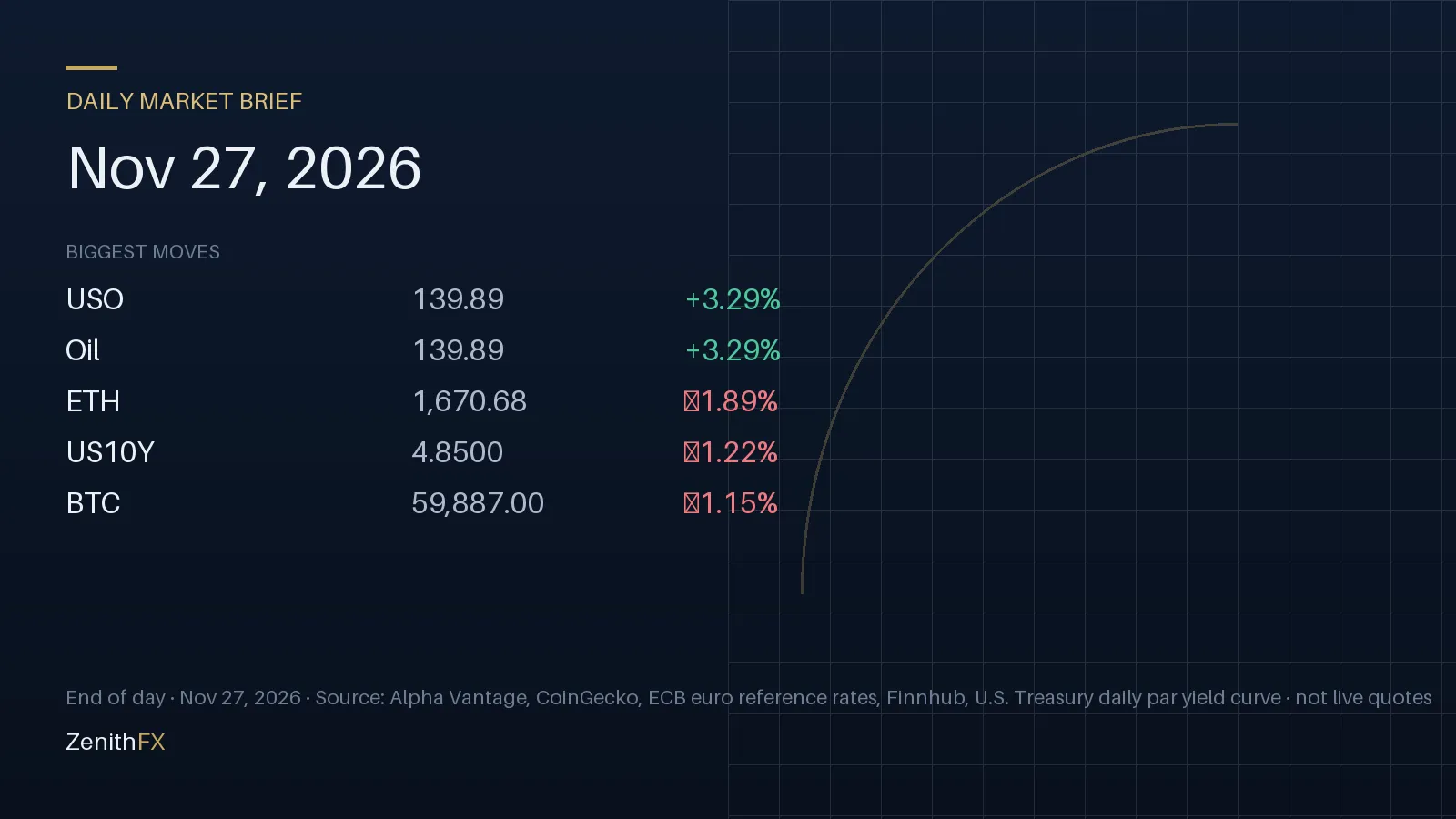
USO 139.89 (+3.29%) · Oil 139.89 (+3.29%) · US 10Y 4.8500 (-1.22%) · US 30Y 5.2400 (-1.13%).
Mixed sources: end-of-day reference values as of 2026-11-27 and quotes delayed by up to 1440 minutes; nothing here is a real-time quote.
What moved
- Gold Rebounds from One-Year Low as AI Sector Jitters Fade and Wall Street Steadies (reported by Reuters and Kitco)
- ECB Consumer Expectations Survey Lands for October 2026 (reported by European Central Bank — press)
- Bank of Japan Reviews Securities Firms' Role in JGB Market-Making (reported by Bank of Japan — what's new)
Why it moved
Gold Rebounds from One-Year Low as AI Sector Jitters Fade and Wall Street Steadies. XAU/USD and XAG/USD are closely watched across forex, futures and ETF markets, and gold's direction often signals broader shifts in risk appetite and rate expectations; a failure to hold this rebound could renew pressure on precious metals futures and related equities.
ECB Consumer Expectations Survey Lands for October 2026. Consumer inflation expectations are a direct input into ECB policy deliberations, so shifts in this survey can reprice European rate futures, move the euro and affect bond yields across the region.
Bank of Japan Reviews Securities Firms' Role in JGB Market-Making. JGB market liquidity conditions affect global rates benchmarks and can ripple into currency and broader fixed-income markets; central bank scrutiny of dealer behaviour often precedes adjustments to market structure rules or operations.
Key events
- ECB Consumer Expectations Survey results – October 2026 — official source: ecb.europa.eu
- (BOJ Review) Developments in JGB Market-Making Business by Securities Companies — official source: boj.or.jp
Markets to watch
- XAU/USD, XAG/USD — linked to: Gold Rebounds from One-Year Low as AI Sector Jitters Fade and Wall Street Steadies
- USO — among the larger moves in the latest reference snapshot
- Oil — among the larger moves in the latest reference snapshot
- US 10Y — among the larger moves in the latest reference snapshot
- US 30Y — among the larger moves in the latest reference snapshot
Educational takeaway
Gold is a non-yielding asset, so when interest rate expectations rise, the cost of holding gold relative to bonds increases — which typically pushes its price lower, illustrating how monetary policy expectations ripple into commodity markets.
Join the discussion
With persistent Fed rate expectations and large-scale sovereign selling acting as headwinds, what conditions do you think would need to change for gold to establish a durable floor? Discuss it in today's Market Huddle.
Sources
ZenithFX summarises reporting and official releases from the publishers below; it did not report these events itself.
- Reuters: Gold rebounds from one-year low as AI jitters ease
- Kitco: Gold, silver reverse early losses as Wall Street rebounds ahead of Thanksgiving - Kitco PM Report
- Livemint: Gold price rebounds from one-year low, but experts feel sentiment remains fragile — Check key factors affecting outlook
- VnExpress International: Gold prices rise
- BigGo Finance: Gold Falls Below $3,500 Mark as Russia Offloads 72 Tons Over Ten Straight Months, Becoming Biggest Selling Pressure
- European Central Bank — press: ECB Consumer Expectations Survey results – October 2026
- Bank of Japan — what's new: (BOJ Review) Developments in JGB Market-Making Business by Securities Companies
Explain simply — 2 terms in this article, in plain language
- Bond yields
- The annual return a bond pays relative to its price. When a bond's price falls, its yield rises, and the other way round.
- Leverage
- Controlling a position larger than the money you put down. It magnifies gains and losses by the same factor. Leverage changes the size of mistakes, not the odds of being right.
Editorial definitions, not advice. All plain-language terms
Discuss this article
The ZenithFX desk opened a moderated discussion on this article.